
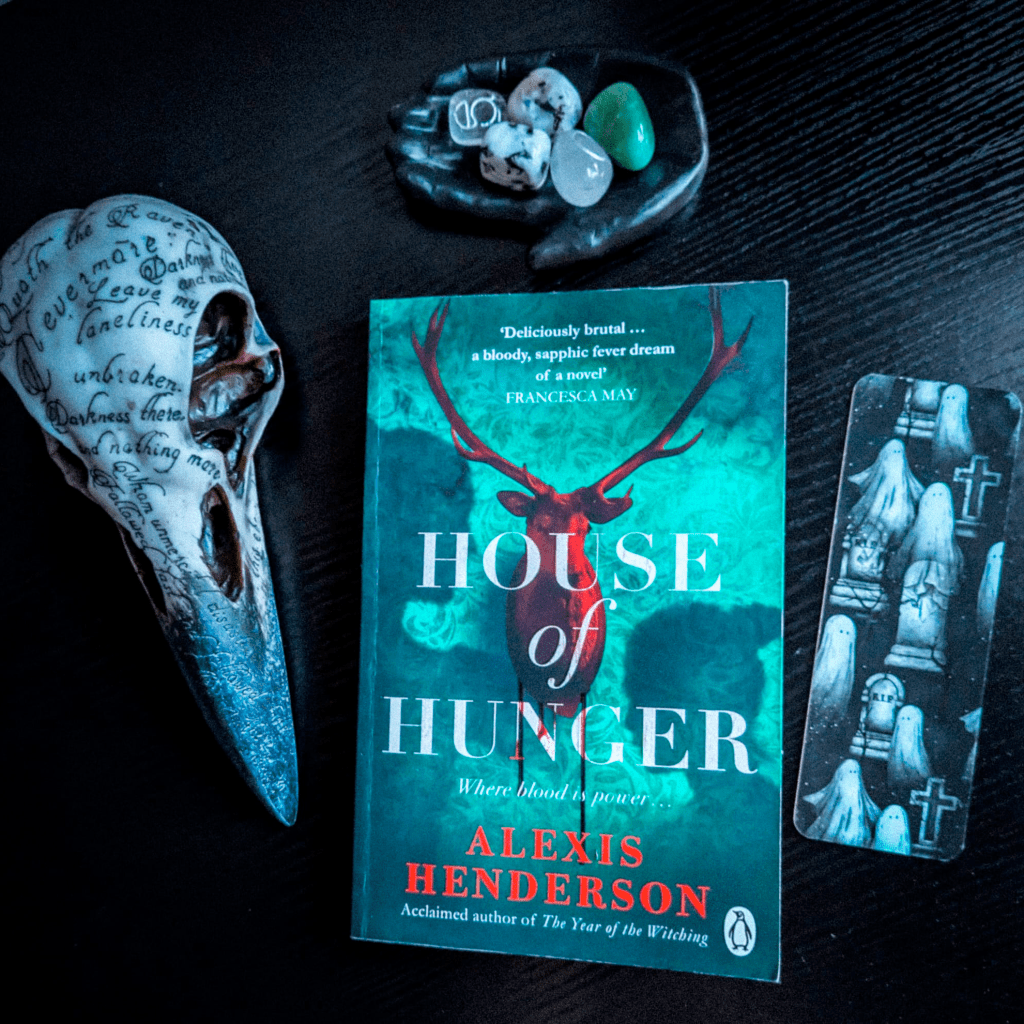
“We’re broken into submission, by grief and poverty, long before we ever set foot in this House. And then we arrive, on the promise of the first kindness many of us have received in years, and you take advantage of our weakness. You cultivate it, to better exploit us.”
― Alexis Henderson, House of Hunger
House of Hunger is a dark gothic horror novel, soaked in blood, wine, and depravity, following Marion Shaw’s path to becoming a bloodmaid in the North.
This book was gifted to me by a friend (Hi Ami!) who’d seen I’d enjoyed a similar book on Goodreads and thought I’d enjoy it, and I really did. House of Hunger is a gory, gothic, and sapphic horror novel all in one.
Raised in the southern city of Praine, her parents having died long ago, Marion lives in poverty while trying to care for her unwell brother. Making paltry amounts of coin by cleaning for a supercilious member of the city’s upper class, she wants for everything. In a land where blood is power, bloodmaids are young women who are hired to bleed for the upper classes of the north – the rarer the taste of their blood, the more they are sought after. The powerful houses of the North believe that the blood of young women will treat their ailments and keep them young, so they employ “Tasters” who seek out those with the rarest and best-tasting blood. Marion applies to one such advertisement placed by a Taster and subsequently begins her indenture as a bloodmaid in the House of Hunger, learning just the level of bloody horror and depravity that comes with her new role.
Alexis Henderson, House of Hunger“Sometimes I feel like I’ve been building you a House out of my own bones. And still, you look at me with so much contempt and mistrust. You complain because there are gaps in the roof of my ribs, and you ask me to give more of myself to fill them. You want my hips to be the bowl you drink from. My shoulders, your bed. My arms, your walls. My legs, the very ground you stand on. You want your fill of my blood whenever you crave it. What more do you want from me?”
The House of Hunger is lorded over by Countess Lisavet Bathory and Marion is soon enthralled by her; always aiming to please her, falling into a desperate and obsessive kind of love. She completes with the First Bloodmaid, Cecilia, for Lisavet’s affections, eventually becoming the First Bloodmaid when Cecilia suffers a wretched breakdown and is sent away, which earns Marion the distrust of her fellow bloodmaids.
The deeper Marion becomes enmeshed with Lisavet, the more she uncovers the dark secrets of the House of Hunger, and Lisavet’s own secrets. Learning about the disappearances of all of the previous bloodmaids, she realises Cecilia was never sent away at all and has met a much worse fate, hidden in the cold and secretive walls of the house.
I couldn’t put this book down and managed to finish it in two days. The prose is rich, thrilling, and so descriptive I could almost taste the tang of the bloodwine drank by Lisavet. I loved Lisavet’s name too – as a nod to the “Bloody Countess” herself, Elizabeth Báthory, who is a historical figure draped in morbid intrigue. Henderson has done an amazing job of creating intrigue and suspense – Lisavet’s compulsion to drink blood comes from far more than the desire to stay young for example, and while it’s hinted that she may not be entirely human, we never find out for sure just exactly what she is, giving the book some spooky, supernatural undertones. She also did a great job at portraying the depravation of Marion’s position, and why she’d be so tempted to join a line of work that’s considered to be taboo in the South.
Gothic horrors also tend to either be deeply psychological in having the protagonist fear for their sanity, or fearing a violent threat to their physical wellbeing. Henderson creates both fears in this book, and they work very well in tandem with each other; fearing that Marion will lose both her mind and body in her work.
The House of Horror is well-paced, and it’s Victorian-steampunk setting makes for an atmospheric backdrop for all of the horror it contains. The vivid and violent nature of the storytelling reminded me of Crimson Peak, another one of my favourite gothic horrors. My only critique is that I’d love to have seen more world-building and I’m curious for details about the other houses. Do those Lords suffer the same ailment as Lisavet, for example? However this does leave the way open for a sequel, or even a prequel – and I really hope we get to find out more details in the future.
Rating:






Leave a comment