
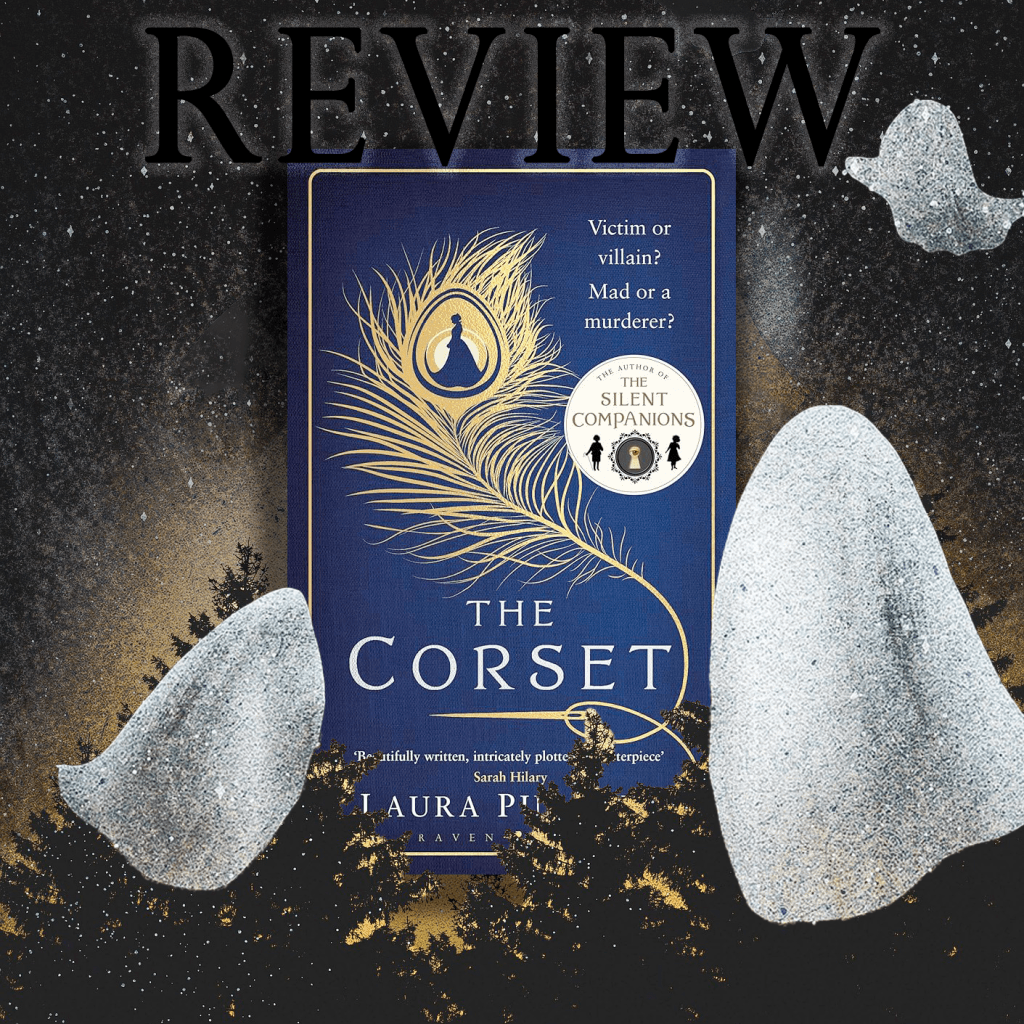
“Grief is a violent emotion, a sort of acid that eats away at the best parts of us. The bereaved are in agony, yearning for someone to blame, and if they cannot find a culprit, they turn their fury upon themselves.”
Laura Purcell, The Corset
I’m back on with tackling my list of Gothic literature, and The Corset by Laura Purcell did not disappoint. Being a Gothic novel set in the Victorian period, it has a heavy focus on themes of poverty, murder, and death. Something the Victorians are renowned for being morbidly obsessed with, so this is the perfect setting for such a Gothic story.
The Corset follows the two perspectives of Dorothea and Ruth: one a lady, the other one a supposed criminal who grew up in poverty. Dorothea wrestles with the controlling nature of her father, and the societal expectations of her to settle down and marry, all while discovering the disturbing truth of her mother’s death. Whereas as Ruth’s story unfolds, we’re left questioning whether she did actually do what she’s accused of, and if the powers she claims to have truly exist.
“Existence as a society wife must be akin to standing in a bog. That slow, sinking sensation. I would be dragged down day by day, grow vacuous and preoccupied with frivolity like those around me.”
Laura Purcell, The Corset
The two different perspectives offer a stark contrast: Dorothea’s is rooted more in reality and her charity work. With a smaller commentary on religion, and how she wishes to be a practicing Catholic as her mother was before her, in a largely Protestant time. Indeed this era in history saw Catholics discriminated against, with the official religion of the crown being the Church of England. Prior to The Roman Catholic Relief Act of 1829, Catholics couldn’t even join Parliament as MPs, or hold higher offices of the judiciary. Otherwise, it appears her biggest concern is avoiding being married off to one of the many suitors her father considers suitable, as she would rather continue her work and marry her secret love; a constable named David, who occupies a societal standing much lower than hers.
Ruth’s perspective on the other hand, is a harsh commentary on the poverty she lives in. It’s dark, and desperate. As we see her family slowly fall apart due to death and grief, it’s clear they were living on a knife edge to begin with. So upon the death of her father, her and her mother are left with very little to their names except for Ruth’s talent at sewing. To this end, she becomes an “apprentice” of Mrs Metyard, the seamstress who owns the shop Ruth’s mother completed work for, but this apprenticeship is more akin to entering indentured servitude. Ruth is provided for, but she must work for Mrs Metyard until she as worked off not only her mother’s debt, but the cost of her own lodging and food too. And even then, she’s given the bare minimum: foul tea and a straw bed in a mouldy cellar to sleep in.
“But instead I shared the fate of all girls who are poor of pocket: I was tied to my work, like a needle tethered by thread.”
Laura Purcell, The Corset
Dorothea and Ruth’s stories become intertwined, as Dorothea visits Ruth in prison in the present day, as part of her charitable efforts; being involved in the running of a women’s prison, she takes time to visit and speak to many of the inmates. As such, Ruth’s story is relayed to us as if Dorothea is the scribe. Whereas Dorothea’s chapters feel more as if they’re written in her own diary.
Every time Ruth sews it seems to coincide with a tragedy or death. She blames herself for every ill that befalls her family and the customers of Mrs Metyard. She becomes convinced she holds a supernatural power which is expressed through her sewing. Purcell writes this exceptionally well as you’re almost believing that it is the case. However, by the end of the book, it’s revealed to be nothing more than circumstantial. Despite how horrified she is at her actions though, it’s almost like Ruth clings to the idea that she could have some semblance of supernatural power throughout her retelling. Which given her circumstances, is likely the only way she felt she had any semblance of control over her poverty-stricken reality, and her life.
The use of poison, specifically arsenic, features heavily in this story alongside Ruth’s ability too. Which is so quintessentially Victorian; they loved a good poisoning. Murder in the 19th century was actually quite rare, but that didn’t stop the morbid fascination for it. The use of poison however, was much more common. This was mostly due to how easily accessible it was: arsenic was available as a dye, in cosmetics, and even as a method to kill household pests. The latter end of the 19th century saw a number of sensationalised poisoning cases, prompting greater governmental control over how readily available poisons were. That didn’t prevent the media frenzy and moral panic concerning the use of poison though.
During this period [1837-1838], a total of 555 people were known to be killed by some form of poison. Out of the 445 of these cases for which an immediate cause of death is available, 194 entailed accidental poisonings, 242 involved suicide; only nine concerned murder victims.
Dartmouth Undergraduate Journal of Science, Sensational Murders: A Poisonous History of Victorian Society
The contrasting methods of death in The Corset are also interesting and very much reflect Victorian attitudes towards gender and violence. Historically, poison was seen as a “feminine” method of murder, due to it’s more subtle nature and being a “clean” way of achieving death – in that it’s not physically violent or bloody. Whereas male methods have typically been much more physically violent and bloody, which is reflected in The Corset. When acts of violence and abuse are being committed by Mrs Metyard, it’s not actually her; in her mind, she’s her decreased husband, as she’s wearing his old military uniform and adopting his voice. Ruth’s father’s death is much more physically violent too, as he takes his own life with a gun. Whereas Ruth’s “victims” are largely taken down by her supposed powers – which we later find out to actually be poison. This does contrast with the way Dorothea’s father kills her mother; which involves the use of poison too. However, I think this still reflects Victorian attitudes as at that point in Dorothea’s story, her father’s authority and position as head of the household had been undermined by her mother converting to Catholicism. This is also suggested as being the impetus for Dorothea’s father poisoning her mother; which he slyly covers up as illness, with her conversion being a symptom of how out of her right mind she was. Dorothea’s father touches on this himself, when asking Dorothea if she realised how much her mother’s conversion impacted their family’s image and standing in society. There’s also an argument to be made for whether Dorothea’s father’s death at the end of the book is subtle or violent too; but I’ll cover this later on.
Whilst I’m talking about the Victorian’s love of murder, there’s a really interesting book all about this and how it shaped the future of policing in the UK. It’s called The Invention of Murder: How the Victorians Revelled in Death and Detection and Created Modern Crime, by Judith Flanders. It’s extremely interesting and gives so much insight into the morbid and macabre fascination that the Victorians had for murder, and the changes in the justice system that came around as a result.
The Corset is a fantastic example of Gothic literature in this setting, and has a suitably Gothic ending too: there’s some justice but it’s not quite a happy ending. However, I did feel a little disappointed by the ending. The cause of her father’s death was quite vague and it was probably intentionally done to hint that Dorothea is the one with supernatural powers, or perhaps it was a final act by Ruth, but this just fell a little flat for me. Her father is found in his study, with swollen red welts all around his neck and appears to have been hanged. And in his hand is the handkerchief embroidered with Ruth’s initials as she wanted them to be, in her own hair, which we thought Dorothea left in a package at Billy’s door.
My personal theory is Dorothea being stung by a wasp was subtle foreshadowing for her father’s death. This happened when Dorothea began to learn what really caused her mother’s death, in a cemetery no less. I suspect the handkerchief in the “package” she leaves for Billy, was actually placed upon her own door, and she included a wasp or two. This is just speculation based upon her father being found with his face swollen and red, and with marks around his neck, “as if he’d been hanged” which could also just be a severe allergic reaction. However, it’s never suggested earlier in the book that her father had an allergy to wasp stings, so we’ll never know for sure.
Returning to the representations of murder by gender in The Corset, if we believe Dorothea to be the cause of her father’s death this is arguably much more violent than the other murders committed by women in this book. While she hasn’t done it with her own hands, the description that he “appeared to have been hanged” is much more violent imagery. Which perhaps is a nod to Dorothea’s desire for independence despite being a Victorian woman, and also her distaste at just settling down and becoming a “society wife.”
Themes and tropes:
- Gothic horror
- Victorian era
- Hint of supernatural gifts
- Many plot twists
- Betrayal
- Scheming
- Female main characters
- Dual perspective
- Rich vs poor
- Vengeance
Trigger warnings:
- Death
- Suicide
- Graphic descriptions of disease and poisoning
- Mental illness
- Addiction
- Death of an infant
- Physical illness
- Poverty
- Violence
- Abuse
- Racism (appropriate to Victorian attitudes and not a reflection of the author’s actual views)
- Misogyny
All in all, I’ve been a fan of Laura Purcell’s books for a while. I’ve previously read The Silent Companions, The Whispering Muse, and The Shape of Darkness, and I loved all three. The Corset is another great book in the Gothic literature genre, and I’ve even more of her books on my TBR pile to get through!
Rating:






Leave a comment